

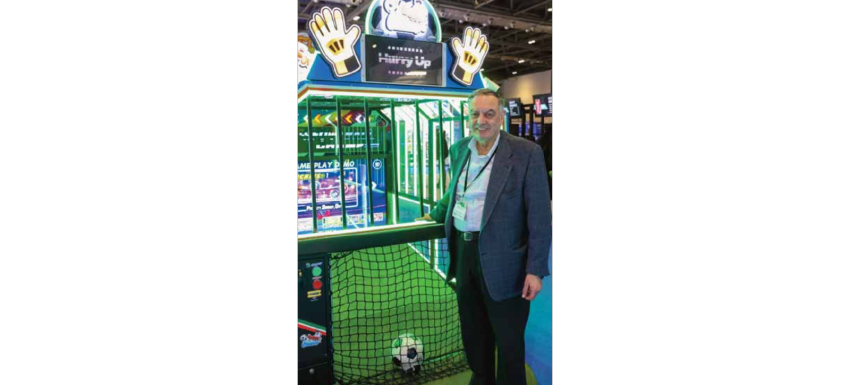
Electrocoin’s managing director and founder John Stergides talks EAG and reflects on why timing is everything when it comes to EAG, together with product performance and policy pressures.
Stergides talks EAG. Coinslot: How did this year’s EAG go for you?
John Stergides Snr: Footfall wasn’t necessarily everything we hoped it might have been. But there were a number of customers who went overseas for the holidays.
Nevertheless, of the customers that came, those who attended came to buy. You always expect more, but it was definitely good for us. We’ve done business, I cannot complain.
I like EAG and I want to see it succeed. But given this, I’d be in favour of moving it to early in December or after the half term holidays in February or later. But I do think it would be a good moment to go back to the drawing board on the timing.
Coinslot: What were some of your product highlights at this year’s EAG?
John Stergides Snr: This year we presented Dance Dance Revolution X from Konami. It’s a UK-first which we had flown in specially from the US. The reception was unbelievable, we had visitors playing it the entire time during EAG.
I’m very proud because we’ve done a lot of sales, we’ve sold all the first production run until around September.
The ROI on these dance machines is fantastic. When customers invest in one, they can be confident they’re buying something which will steadily make them money for the next 20 years.
Another of our highlights at this year’s EAG was Football Champ. Co-developed with a partner in China, this title represents a completely new, skill-based football game concept, encouraging maximum player participation, and with an engaging penalty shoot-out feature.
Meanwhile, we also spotlighted our Bar-X 7even, the original version of this 3-reel, land-based title was first introduced way back in 1981. It’s the longest-running machine in production in the UK!
Coinslot: How would you say you gauged the general mood of the industry at this year’s show? (Stergides talks EAG)
John Stergides Snr: The main talking points this year were about the government and concerns about the possibility of more restrictions. In terms of policy, there has been nothing introduced that would help the industry create new jobs or drive growth.
What the industry needs is a more flexible, pragmatic approach from government, similar to what we had 20 years ago. The triennial reviews, for example, recognised the sector as a legitimate business and considered evidence, rather than simply reacting to the kind of negative headlines we’ve seen in recent years.
Unfortunately, the press is often hostile towards gambling, and that narrative tends to dominate. A small number of negative examples are amplified and used to justify measures that affect everyone, even though the vast majority of operators are compliant and responsible.
Another growing issue is access to banking. Some banks are now refusing to do business with amusement and gaming companies simply because they hold a gambling licence. That’s despite the fact that this is one of the most tightly regulated industries in the UK. Thankfully, not all banks take that view, but the wider trend is concerning.
Coinslot: What are the key challenges facing the sector right now?
John Stergides Snr: Every time gambling legislation is reviewed, the outcome seems to be more restrictions. Instead of being given the tools to expand production in the UK and develop more games domestically, the industry is faced with measures that create uncertainty and make businesses nervous.
The wider economic climate doesn’t help either. Budget pressures affect disposable income, and amusements are, by their nature, a discretionary spend. When people are short of money, entertainment is often the first thing they cut back on.
Historically, there’s been a clear pattern. When the economy is strong and there’s money in the market, spending on amusements and entertainment increases. When money is tight, that spending falls away.
On the other hand, gambling behaves differently. During recessions, gambling can actually increase, because people believe they might win money. It’s almost the opposite dynamic.
(Stergides talks EAG)
Coinslot – Jan 23 – Jan 29, 2026 – Issue No 2977, Page 36